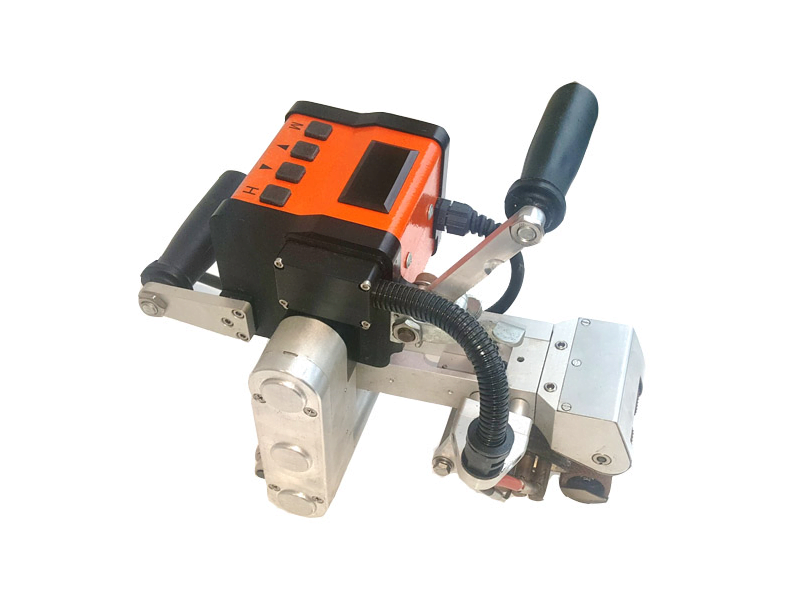
Geomembrane Welding Machines
FHW100 Geomembrane Welding Machine
The FHW100 is a lightweight, portable automatic hot air welding machine that welds thermoplastic geomembranes, including PVC and HDPE, with the same machine.
ReviewAutomatic hot air welding machines for on-site welding of PVC, HDPE, LDPE and PP geomembranes — the lightweight, portable FHW100 and the high-speed FHW200.
The FHW100 is a lightweight, portable automatic hot air welding machine that welds thermoplastic geomembranes, including PVC and HDPE, with the same machine.
Review
The FHW200 is a high-speed 2500 W automatic hot air welding machine that welds thermoplastic geomembranes, including PVC and HDPE, with the same machine.
ReviewA geomembrane welding machine is field equipment that joins the overlap seams of thermoplastic geomembrane liners used in structures such as ponds, pools, canals and landfills, using controlled heat, pressure and a constant travel speed. The Fortiweld FHW series welds automatically with hot air.
Geomembrane welding machines are used to join, on site, the seams of thermoplastic liners installed for containment and waterproofing. The Fortiweld FHW series are automatic hot air welding machines: the machine travels along the overlap line, brings the surfaces up to welding temperature with hot air and applies pressure to form a continuous seam. The series consists of two models: the lightweight, portable FHW100 and the FHW200, which offers higher power and speed.
In geomembrane welding, two liner edges are overlapped and the machine travels along this overlap line at a constant speed. Three settings determine weld quality: temperature, travel speed and pressure. These settings are readjusted whenever the material type, thickness or ambient temperature changes; a trial seam is therefore recommended before starting the actual work and whenever conditions change.
The FHW100 and FHW200 weld PVC, HDPE, LDPE and PP geomembranes and similar thermoplastic liners. The same machine can be used for both PVC and HDPE work by adjusting temperature and speed to the material, so separate equipment is not needed for different projects. Both models work in a material thickness range of 0.5–3 mm.
The FHW100 has 1500 W of power, an operating temperature of 20–420 °C and a welding speed of 1.2–4 m/min. Weighing 6.3 kg and measuring 300 × 220 × 200 mm, it is easy to carry in confined spaces, on repair jobs and on sites where the equipment is moved frequently.
The FHW200 offers 2500 W of power, an operating temperature of 20–450 °C and a welding speed of 1.2–7.0 m/min. It weighs 9.5 kg and works at a higher travel speed on large-area lining jobs with long seam runs.
After welding, the seams are tested for leak-tightness on site. The equipment used for this applies controlled compressed air to the seam and reveals leaks non-destructively.
On PE and PP geomembranes, extrusion welding is used for details the automatic machine cannot reach, such as corners, pipe penetrations and patches.
Fortiweld provides technical support for thermoplastic welding equipment, from product selection through to application. FHW series machines run on a 220 V supply and are portable on site. Final weld performance depends on material thickness, surface cleanliness and ambient conditions; contact our technical team to identify the right model for your project.
| Specification | FHW100 | FHW200 |
|---|---|---|
| Voltage | 220 V | 220 V |
| Power | 1500 W | 2500 W |
| Operating Temperature | 20 – 420 °C | 20 – 450 °C |
| Welding Speed | 1.2 – 4 m/min | 1.2 – 7.0 m/min |
| Material Thickness | 0.5 – 3 mm | 0.5 – 3 mm |
| Compatible Materials | PVC · HDPE · LDPE · PP | PVC · HDPE · LDPE · PP |
| Weight | 6.3 kg | 9.5 kg |
| Dimensions | 300 × 220 × 200 mm | 330 × 240 × 250 mm |
Values are taken from the product specification tables; see the relevant product page for details.
The scale of the job and site conditions determine the model choice:
Share the material type, thickness and daily seam length, and the Fortiweld technical team will recommend the right model.
The main factors affecting the price of a geomembrane welding machine:
For a project-specific price, share the material type and approximate seam length; our technical team will prepare a quotation.
Share your material type, thickness and site conditions; the Fortiweld technical team will recommend the right model for you within 48 hours.